

Many taxpayers reach April and realize they are not ready to file. Missing forms, complex income, or life changes can delay everything.
Filing an extension solves that problem, but only if you do it correctly.
Many people assume an extension removes deadlines. That is not true. Errors with extensions often lead to penalties, interest, or rejected filings.
This guide explains how to file a tax extension, what deadlines matter, and what mistakes to avoid so you stay in control of your return.
Key Takeaways
- An extension gives you more time to file—not more time to pay. Your filing deadline moves to October 15, but taxes are still due by April 15 to avoid penalties and interest.
- Filing correctly prevents costly mistakes. Common errors—like not estimating taxes owed, missing deadlines, or skipping state requirements—can lead to fines or rejected filings.
- The process is simple if you follow the steps. Estimate your tax liability, file Form 4868 (online, by payment, mail, or with a professional), and pay as much as you can upfront.
- Extensions work best for complex or incomplete returns. If you are waiting on documents, managing multiple income sources, or dealing with life changes, extra time helps you file accurately.
- Taking action now protects your outcome later. Filing on time, even without full payment, reduces penalties and gives you space to organize records, review deductions, and avoid rushed decisions.
What a tax extension actually does (and what it does not do)
A tax extension gives you more time to file your return. It does not give you more time to pay.
Here is how it works:
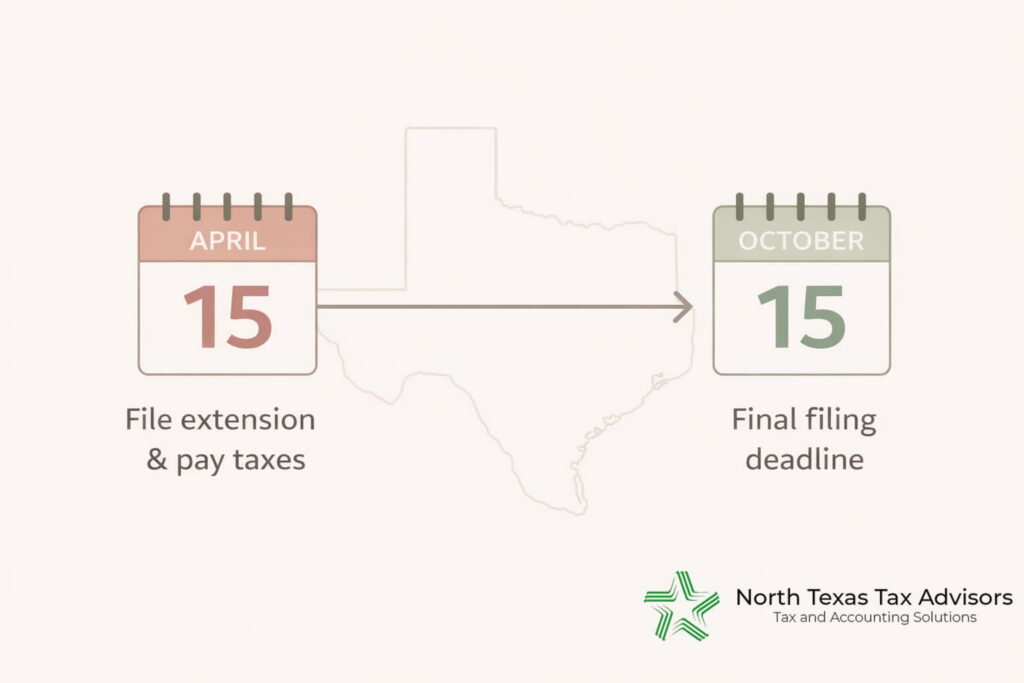
- Filing deadline moves from April 15 to October 15
- Payment deadline stays April 15
You must estimate your tax bill and pay what you owe by April. If you do not, the IRS may charge penalties and interest.
To review official rules, see the IRS extension guidance and Form 4868 overview.
Who should file a tax extension
Filing an extension is common and often a smart decision.
Late starters
You are still waiting on documents such as 1099s, K-1s, or corrected forms.
Complex filers
You have business income, investments, rental property, or multiple income streams.
Life changes
You experienced marriage, divorce, a move, or a new child.
Accuracy matters more than speed
You want time to review deductions and avoid errors.
An extension gives you time to file correctly instead of rushing.
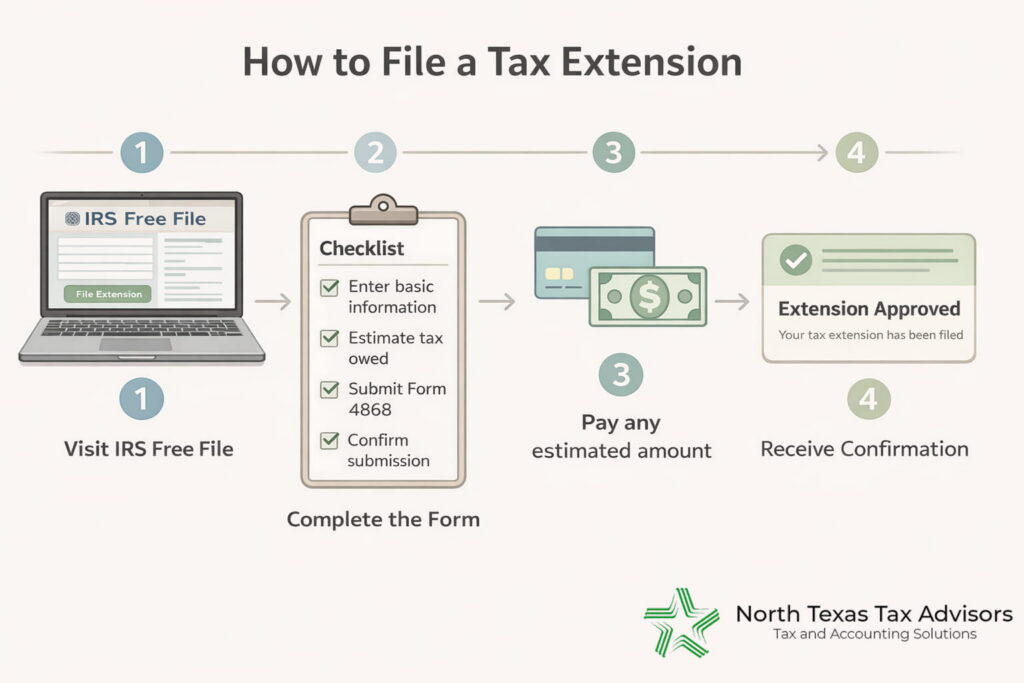
How to file a tax extension step-by-step
This process is simple when you follow the steps in order.
Step 1: Estimate your tax liability
Start with your prior-year return.
- Estimate your total income
- Subtract withholding and estimated payments
- Calculate what you still owe
This step matters because payment is still due in April.
Step 2: Choose how to file
You have four main options.
Option A: File a tax extension online (most common)
Use the IRS Free File system.
- No income limit
- Fast confirmation
- Easy submission
Access it here:
IRS Free File extension option
Option B: Pay online and file automatically
You can file your extension by making a payment.
- Use IRS Direct Pay or card payment
- Select “extension” as the reason
- No separate form required
Pay here:
IRS Direct Pay
Option C: Mail Form 4868
Complete and mail Form 4868 before April 15.
Download the form:
Form 4868 instructions
Option D: Work with a tax professional
A tax advisor can:
- Estimate your liability
- File the extension
- Plan your next steps
Step 3: Pay what you owe
Even if you file an extension, payment is still due by April.
Pay as much as you can to reduce penalties.
How to file a tax extension online
If you want the fastest method, follow these steps:
- Go to IRS Free File
- Submit Form 4868 electronically
- Save your confirmation
Or:
- Make a payment online
- Select “extension”
- Keep your receipt as proof
This process usually takes less than 15 minutes.
Tax extension deadlines you must know
Keep these dates clear:
- April 15
- File your extension
- Pay taxes owed
- October 15
- File your completed return
State deadlines may differ. Always confirm your state rules.
Common mistakes when filing a tax extension
These mistakes cause most problems.
Mistake 1: Thinking an extension delays payment
It does not. Payment is still due in April.
Mistake 2: Not estimating taxes owed
This leads to penalties and interest.
Mistake 3: Missing the April deadline
If you miss it, you do not get the extension.
Mistake 4: Forgetting state extensions
Some states require a separate filing.
Mistake 5: Not confirming submission
Always keep proof of filing or payment.
What happens after you file an extension
Once you file:
- You have until October 15 to submit your return
- You can file at any time before that
Use this time wisely.
- Gather complete records
- Review deductions
- Avoid last-minute errors
What if you still cannot pay your taxes
If you cannot pay in full:
- Pay as much as possible now
- Set up a payment plan later with the IRS
Filing on time reduces penalties, even if you owe money.
State tax extensions: what to check
State rules vary.
- Some states accept your federal extension
- Others require a separate form
Check your state tax agency to confirm requirements.
Why filing an extension can be a smart move
An extension is not a failure. It is a strategy.
It helps you:
- Avoid rushed mistakes
- Review deductions carefully
- Plan your tax outcome
Many complex returns benefit from extra time.
When to work with a tax professional
Some situations require more than basic filing.
You may benefit from help if you have:
- Multiple income sources
- Business ownership
- Large deductions or credits
- Prior-year tax issues
You can explore:
FAQ: How to file a tax extension
How do I file a tax extension?
You can file online through IRS Free File, pay online and mark it as an extension, mail Form 4868, or work with a tax professional.
How do I file a tax extension online?
Use IRS Free File or make an online payment and select “extension.” Both methods file your extension electronically.
Is there a penalty for filing an extension?
There is no penalty for filing an extension. Penalties apply only if you do not pay taxes owed by April.
What happens if I don’t file by April 15?
You may face failure-to-file penalties if you do not file or request an extension.
Do I need to file an extension if I expect a refund?
You are not required to, but it is still a good safeguard.
Can I file a tax extension electronically?
Yes. Most taxpayers file extensions online using IRS tools.
Your Next Step: File Your Extension with Confidence
If you are not ready to file yet, that is okay. What matters is taking the right next step now.
Start simple:
- Get a rough estimate of what you owe
- File your extension before the deadline
- Pay what you can today
- Keep your confirmation for your records
Once that is done, you give yourself something most people rush through—time.
Time to gather the right documents, review your numbers, and make better tax decisions instead of quick ones. If you want a second set of eyes or a clear plan before October, we can help.
