

A raise should feel like progress. But many people notice something confusing after a pay increase: the paycheck grows, yet the take-home amount feels smaller than expected.
This often happens because of federal tax brackets and payroll withholding.
Each year, the IRS adjusts tax brackets to account for inflation and prevent what economists call “bracket creep.” These adjustments change how income is taxed and how much employers should withhold from paychecks.
For 2026, several key thresholds increased again, including the standard deduction and the income levels for each federal tax bracket.
Understanding the IRS 2026 tax brackets can help you estimate your tax bill, adjust your withholding, and avoid surprises when you file your return.
Quick Definitions (So the Rest Is Easy)
Before diving into the numbers, it helps to understand a few key terms.
Taxable income
Taxable income is your total income minus adjustments and deductions. The IRS explains this calculation in detail in IRS Publication 17, Your Federal Income Tax, which outlines how taxable income is determined.
Marginal tax rate
Your marginal rate is the tax rate applied to your highest dollar of income.
For example, if part of your income falls in the 24% bracket, your marginal rate is 24%.
Effective tax rate
Your effective rate is the overall percentage of income you actually pay after applying all brackets.
This number is usually lower than your marginal rate.
A common myth
Moving into a higher tax bracket does not mean all your income is taxed at that rate. Only the portion that falls into the higher bracket receives that rate.
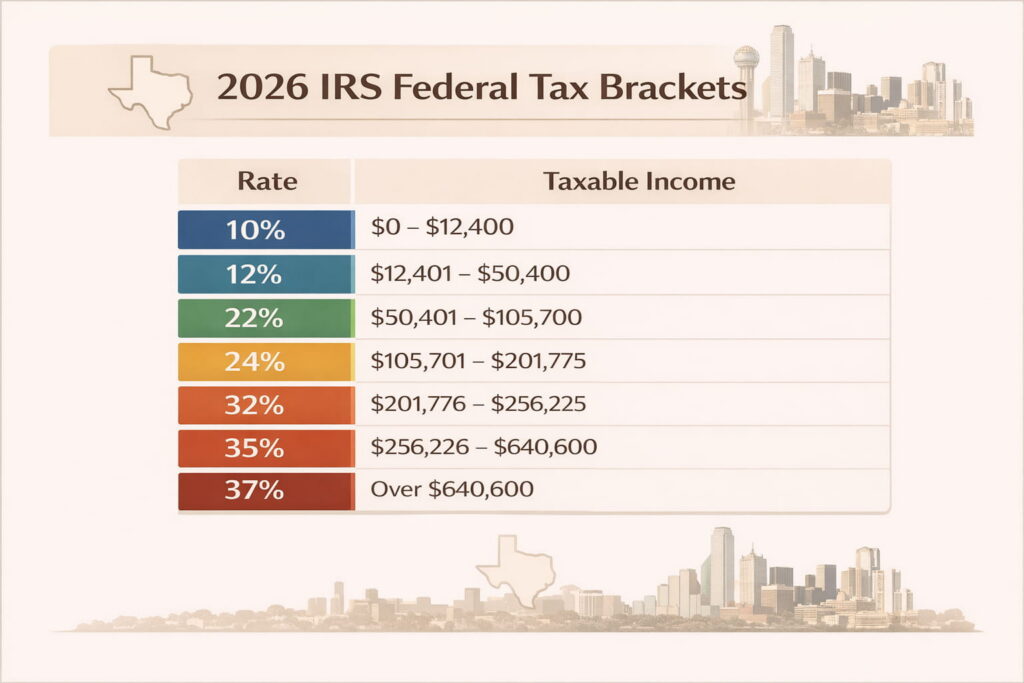
The IRS 2026 Tax Brackets at a Glance
The federal income tax system continues to use seven tax rates in 2026:
10%, 12%, 22%, 24%, 32%, 35%, and 37%.
The income thresholds increased slightly due to inflation adjustments. These changes were announced in the IRS news release on tax inflation adjustments for tax year 2026.
2026 Federal Tax Brackets — Single Filers
| Rate | Taxable Income |
|---|---|
| 10% | $0 – $12,400 |
| 12% | $12,401 – $50,400 |
| 22% | $50,401 – $105,700 |
| 24% | $105,701 – $201,775 |
| 32% | $201,776 – $256,225 |
| 35% | $256,226 – $640,600 |
| 37% | Over $640,600 |
2026 Federal Tax Brackets — Married Filing Jointly
| Rate | Taxable Income |
|---|---|
| 10% | $0 – $24,800 |
| 12% | $24,801 – $100,800 |
| 22% | $100,801 – $211,400 |
| 24% | $211,401 – $403,550 |
| 32% | $403,551 – $512,450 |
| 35% | $512,451 – $768,700 |
| 37% | Over $768,700 |
These brackets apply to income earned during 2026, which will be reported on tax returns filed in 2027.
Standard Deduction Changes for 2026
The standard deduction increased again in 2026.
This deduction reduces taxable income before brackets are applied, which means it directly affects how much tax you pay.
2026 Standard Deduction
| Filing Status | Deduction |
|---|---|
| Single | $16,100 |
| Married Filing Jointly | $32,200 |
| Head of Household | $24,150 |
For comparison, the 2025 standard deduction was:
| Filing Status | 2025 |
|---|---|
| Single | $15,750 |
| Married Filing Jointly | $31,500 |
| Head of Household | $23,625 |
These adjustments come from the IRS inflation updates published in Revenue Procedure 2025-32.
2026 vs. 2025 vs. 2024: What to Compare
Many taxpayers review multiple tax years when planning.
This happens when they are:
- Filing a prior-year return
- Estimating next year’s tax bill
- Adjusting withholding mid-year
When comparing tax years, focus on three key items:
- Tax bracket thresholds
- Standard deduction changes
- Credit phase-out limits
Even small changes in these numbers can affect withholding and estimated taxes.
Planning Around the 2026 Brackets
Understanding your tax bracket allows you to plan ahead rather than reacting when filing a return.
Below are common planning situations we see.
W-2 Employees (Most Taxpayers)
Most employees rely on payroll withholding to pay taxes throughout the year.
However, withholding may fall out of alignment when income changes.
Common triggers include:
- A raise or promotion
- Job changes
- Bonuses or commissions
- Marriage or divorce
- Side income
The IRS provides a Tax Withholding Estimator that helps employees determine whether their current withholding matches their expected tax bill.
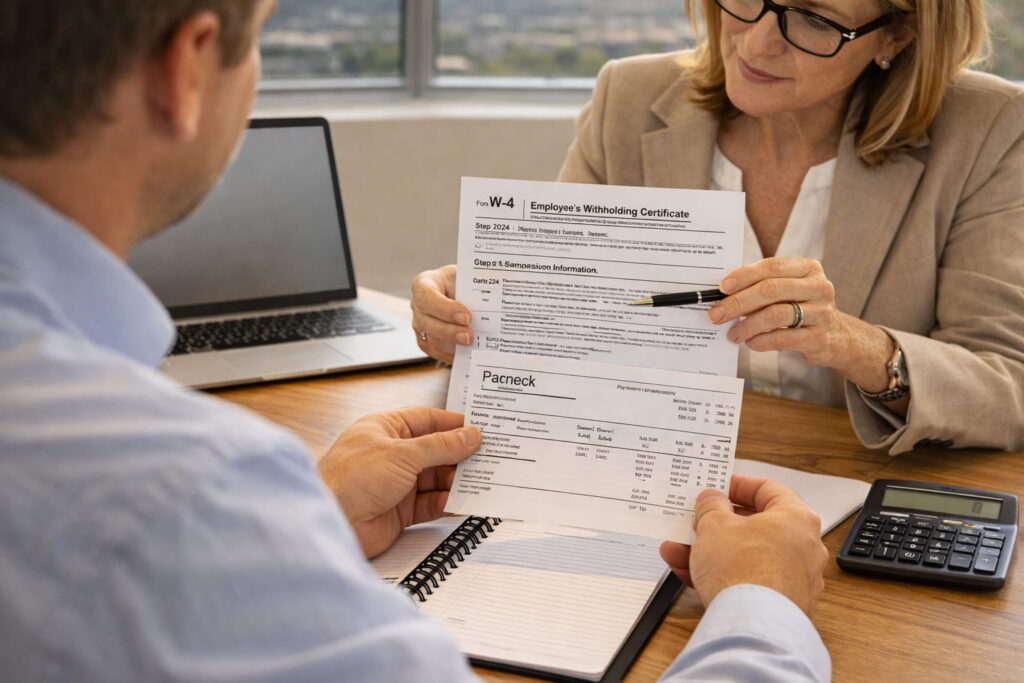
If adjustments are needed, employees can submit a revised Form W-4 (Employee’s Withholding Certificate) to their employer.
Updating this form allows payroll systems to adjust withholding for future paychecks.
New Earners and First Salary Jobs
New professionals often underestimate taxes during their first full-time job.
Common mistakes include:
- Leaving the default W-4 settings
- Ignoring bonus withholding rules
- Overlooking freelance or gig income
A simple mid-year withholding review can prevent unexpected tax balances when filing.
Households With Multiple Incomes
When both spouses work, withholding issues become more common.
Payroll systems calculate withholding per job, not per household.
This means two moderate salaries can sometimes create underwithholding when combined.
IRS guidance for these situations appears in IRS Publication 505: Withholding and Estimated Tax, which explains withholding rules for households with multiple jobs.
Ways to Lower Your Taxable Income
Understanding tax brackets also helps identify strategies that reduce taxable income.
Increase retirement contributions
Contributing to a traditional 401(k) or IRA may reduce taxable income for the year.
Use Health Savings Accounts (HSAs)
HSA contributions can lower taxable income while providing tax-free withdrawals for qualified medical expenses.
Time certain income
In some cases, shifting income between tax years may reduce bracket exposure.
Examples include bonuses, consulting payments, or investment sales.
Manage investment gains
Selling investments at strategic times may help avoid pushing income into higher brackets.
Estimated Taxes and Underpayment Risk
Not all income is subject to employer withholding.
Taxpayers may need to make estimated tax payments when income comes from:
- Freelance work
- Self-employment
- Investments
- Rental income
The IRS expects taxes to be paid during the year as income is earned.
Failing to pay enough during the year may lead to underpayment penalties.
Detailed rules appear in IRS Publication 505, which covers both withholding and estimated tax requirements.
A Simple Year-Round Tax Planning Checklist
Staying ahead of taxes usually requires small adjustments during the year.
January – March
- Review withholding using the IRS estimator
- Confirm W-4 accuracy
Mid-Year
- Adjust withholding if income changes
- Evaluate retirement contributions
Fall / Year-End
- Estimate total taxable income
- Review deductions and credits
- Confirm withholding before the final paychecks
These steps help avoid surprises when filing your tax return.
Frequently Asked Questions About IRS 2026 Tax Brackets
What will my tax bracket be in 2026?
Your 2026 tax bracket depends on three factors:
- Your taxable income
- Your filing status (single, married filing jointly, married filing separately, or head of household)
- Your deductions and adjustments
For example, a single filer in 2026 moves into the 22% bracket once taxable income exceeds $50,400, while married couples filing jointly enter that bracket when income exceeds $100,800.
The IRS publishes official bracket tables each year in its tax inflation adjustment announcement, which outlines the updated thresholds for all filing statuses.
If I make $100,000, what tax bracket am I in?
It depends on your filing status and deductions.
For example:
Single filer example
- Income: $100,000
- Standard deduction (2026): $16,100
Estimated taxable income:
$83,900
That amount would place most of the income in the 22% bracket.
However, only the portion above $50,400 would be taxed at 22%. The rest would still be taxed at the lower 10% and 12% rates.
Your effective tax rate would likely be lower than 22%.
How do I avoid underwithholding?
Underwithholding usually happens when income increases but payroll withholding stays the same.
Common situations include:
- Raises or promotions
- Multiple jobs in one household
- Bonuses or commissions
- Side income or freelance work
A simple way to prevent underwithholding is to run your numbers through the IRS Tax Withholding Estimator, which helps determine whether your paycheck withholding matches your expected tax liability.
If adjustments are needed, you can update Form W-4 with your employer to increase withholding.
Reviewing withholding mid-year often prevents unexpected tax balances when you file your return.
Does moving into a higher tax bracket mean all my income is taxed more?
No.
The United States uses a progressive tax system. Each portion of income is taxed at a different rate.
For example, if part of your income enters the 24% bracket, only the income above that threshold is taxed at 24%.
The earlier portions of income remain taxed at the lower 10%, 12%, or 22% rates.
This layered system means a higher bracket does not apply to your entire income.
Match Your Withholding to the 2026 Brackets
Tax brackets are only one part of the tax equation.
Income sources, deductions, credits, and filing status all affect your final tax bill.
If you want help reviewing your withholding or planning around the IRS 2026 tax brackets, our team can help.
You can explore our Tax Planning Services, learn about our Income Tax Preparation Services, or visit the Tax Center for more resources.
Year-round planning can help you reduce stress, avoid surprises, and make smarter financial decisions before tax season arrives.