

Most taxpayers will take one deduction without realizing how much it matters.
If you are a W-2 employee, retiree, or part of a family filing a joint return, there is a good chance the 2026 standard deduction will do most of the heavy lifting on your tax return. You may never list out mortgage interest, medical costs, or charitable gifts on Schedule A. Instead, you will likely claim one flat deduction amount and move on.
That choice matters more than it may seem. The standard deduction directly reduces taxable income, which can affect your bracket exposure, your withholding, and how much you owe or get back when you file. For tax year 2026, the IRS increased the standard deduction again, and those amounts generally apply to returns filed in 2027. You can see the official update in the IRS 2026 inflation adjustment announcement.
Key Takeaways
- The 2026 standard deduction increased again — For tax year 2026 (filed in 2027), the deduction is $16,100 for single filers, $32,200 for married filing jointly, $24,150 for head of household, and $16,100 for married filing separately.
- Most taxpayers will still choose the standard deduction — Many W-2 employees, retirees, and families do not have enough itemized deductions to exceed the standard deduction, making it the simpler and often larger option.
- Taxpayers age 65+ may qualify for additional deductions — Eligible seniors can add $2,050 for single filers or $1,650 per spouse for married filers, and some may qualify for a temporary $6,000 senior deduction (2025–2028) depending on income limits.
- The standard deduction continues to rise due to inflation adjustments — Compared to earlier years, the deduction increased from $14,600 (2024) to $15,750 (2025) and now $16,100 (2026) for single filers.
- You should compare standard vs. itemized deductions every year — While the standard deduction usually wins, large mortgage interest, medical expenses, charitable contributions, or tax payments can sometimes make itemizing more beneficial.
What is the standard deduction?
The standard deduction is a flat amount you subtract from income if you do not itemize deductions. In simple terms, it is the IRS’s built-in write-off for taxpayers who are not claiming a larger total through itemized expenses.
Most people choose one of two paths:
- take the standard deduction, or
- itemize deductions such as mortgage interest, certain medical expenses, charitable contributions, and some taxes.
You generally use whichever method gives you the lower taxable income. For many households, the standard deduction is simpler and larger than their itemized total, which is why it is so common. The IRS confirmed the updated 2026 amounts in its annual inflation release.

2026 standard deduction amounts at a glance
For tax year 2026, the standard deduction increases to the following amounts:
| Filing status | 2026 standard deduction |
|---|---|
| Single | $16,100 |
| Married filing jointly | $32,200 |
| Head of household | $24,150 |
| Married filing separately | $16,100 |
These amounts generally apply to 2026 income tax returns filed in 2027. The figures come directly from the IRS’s 2026 inflation adjustment release.
2026 vs. 2025 vs. 2024: quick comparison
Readers often search for standard deduction 2025, standard deduction 2024, and what is the standard deduction for 2024 because they are comparing returns across years. Here is the quick version:
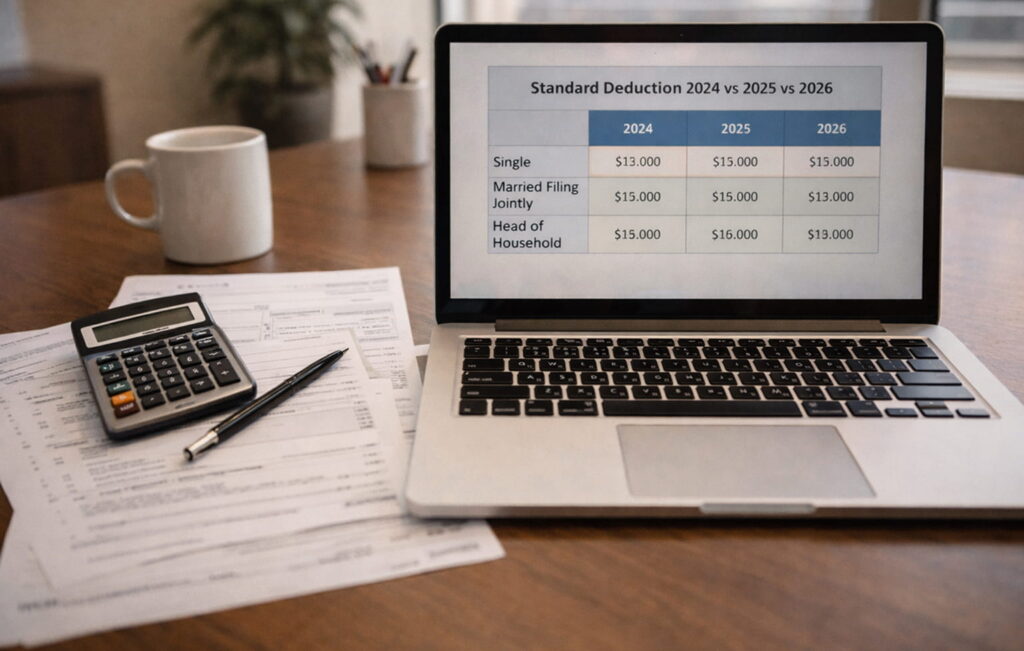
| Filing status | 2024 | 2025 | 2026 |
|---|---|---|---|
| Single | $14,600 | $15,750 | $16,100 |
| Married filing jointly | $29,200 | $31,500 | $32,200 |
| Head of household | $21,900 | $23,625 | $24,150 |
| Married filing separately | $14,600 | $15,750 | $16,100 |
The 2025 and 2026 amounts are listed in the IRS inflation adjustment release, including the OBBB changes for 2025 and 2026.
For 2024 amounts, the IRS published them in the prior-year annual inflation adjustments and they were widely used for returns filed in 2025.
Is the standard deduction going down in 2026?
No. The standard deduction is not being reduced in 2026.
It increased from 2025 to 2026:
- Single: from $15,750 to $16,100
- Married filing jointly: from $31,500 to $32,200
- Head of household: from $23,625 to $24,150
That is one of the clearest takeaways from the IRS update.
Additional deduction amounts for taxpayers age 65 and older
This section matters for retirees and near-retirees because there are now two different senior-related deduction concepts to keep in view.
The traditional additional standard deduction for age 65+
For 2026, taxpayers age 65 or older may qualify for an additional amount on top of the standard deduction:
- Single: $2,050
- Married / surviving spouse: $1,650 per qualifying taxpayer
This is the long-standing age-based add-on many retirees already know.
The temporary senior deduction under the One Big Beautiful Bill
Separately, the IRS says that for 2025 through 2028, eligible individuals age 65 and older may claim an additional $6,000 deduction per eligible taxpayer. This applies to both itemizers and non-itemizers, but it phases out for taxpayers with modified adjusted gross income above:
- $75,000 for single filers
- $150,000 for joint filers
The IRS explains these rules on its One Big Beautiful Bill provisions for individuals and workers page.
For retirees, that means the deduction decision is no longer just “standard or itemized.” It may also involve age-based add-ons and income phaseouts.
Standard deduction vs. itemizing: how to decide
When the standard deduction usually wins
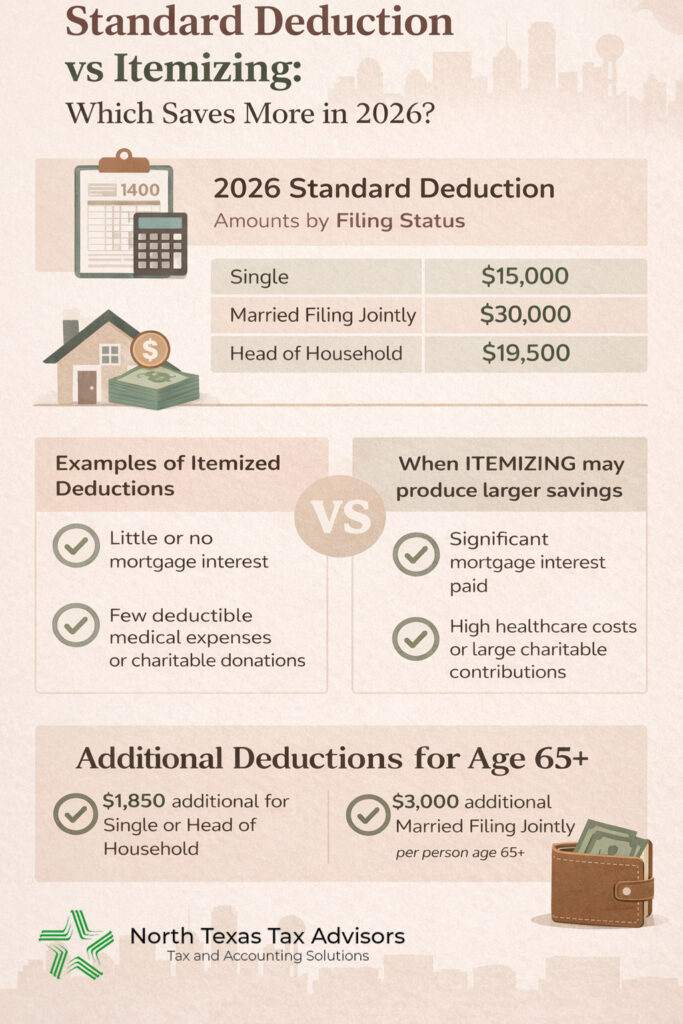
The standard deduction often makes the most sense for:
- W-2 filers with straightforward returns
- retirees with modest deductible expenses
- families without large mortgage interest, major medical costs, or heavy charitable giving
If your itemized deductions do not exceed the standard deduction for your filing status, the standard deduction is usually the better result.
When itemizing may still be better
Itemizing may still win if you have unusually high deductible expenses, such as:
- large mortgage interest
- significant unreimbursed medical expenses that clear the IRS threshold
- large charitable contributions
- higher state and local taxes, subject to federal limits
For some households, one high-expense year can tip the balance toward itemizing even if the standard deduction wins in most years.
Why this should be reviewed every year
This decision should not be made on autopilot. Income, filing status, deductions, home ownership, medical costs, and charitable giving can all change from year to year. The OBBB also adds more moving parts for some seniors, so the best answer this year may not be the best answer next year. The IRS confirms that both standard and itemized approaches remain part of the planning picture.
Why the standard deduction matters for withholding and planning
A higher deduction usually means lower taxable income. That can create a chain reaction:
higher deduction → lower taxable income → potentially lower tax due
That matters for more than just filing season.
Paycheck withholding
If you are a W-2 employee, a higher standard deduction may mean your total expected tax bill is lower than it was under prior-year assumptions. That can affect whether your withholding is too high, too low, or just right.
Retirement income withholding
Retirees often have withholding on pensions, IRA distributions, or Social Security-related income planning decisions. The standard deduction and age-based deductions can change how much of that income is exposed to tax.
Estimated payments and side income
Households with side income, contract work, investment income, or retirement account distributions may need to reassess estimated payments if their deduction picture changes.
This is why year-round planning matters. A deduction is not just a filing detail. It can affect cash flow during the year. If you want help reviewing how these updates fit into your own return, our Tax Planning Services and Income Tax Preparation Services can help you run the numbers in advance. You can also use our Calculators as a starting point.
Common situations by audience
W-2 employees
For many employees, the key issue is not whether they will itemize. It is whether their payroll withholding still makes sense under the newer deduction amounts. If your refund or balance due has been drifting from what you expected, the standard deduction may be one reason to review your paycheck setup.

Retirees
Retirees may have a more layered analysis. The base standard deduction, the age 65+ additional amount, and the temporary senior deduction may all matter. That is especially true if you are drawing from multiple income sources or trying to manage taxable income across pensions, retirement accounts, and Social Security.
Families
Families should pay close attention to filing status. Head of household filers get a different standard deduction amount, and married couples need to compare joint filing math against their total deductible expenses. A year with larger medical bills, mortgage interest, or concentrated charitable giving may produce a different result than the year before.
Simple examples readers can follow
Example 1: Single W-2 employee
Assume a single employee earns $82,000 in wages in 2026 and does not have enough deductions to itemize.
They would likely use the 2026 standard deduction of $16,100. That reduces taxable income to $65,900 before other adjustments or credits. From there, the tax brackets apply to taxable income, not the full $82,000.
Example 2: Married couple deciding whether to itemize
Assume a married couple filing jointly has:
- $12,000 mortgage interest
- $8,000 charitable giving
- $10,000 deductible state and local taxes under the federal limit
That totals $30,000 of potential itemized deductions.
Their 2026 standard deduction is $32,200, so unless they have more deductible items, the standard deduction would still be better.
Example 3: Retired couple over 65
Assume both spouses are over 65 and file jointly in 2026.
They start with the $32,200 standard deduction. Then they may also qualify for an additional $1,650 each under the traditional age-based rules, and possibly the separate temporary senior deduction if they meet the MAGI rules. That can create a much larger deduction package than many retirees expect.
Frequently asked questions
What is the 2026 standard deduction?
For 2026, the standard deduction is:
- $16,100 for single filers and married filing separately
- $32,200 for married filing jointly
- $24,150 for head of household
What is the standard deduction for 2024?
For 2024, the standard deduction was:
- $14,600 for single filers and married filing separately
- $29,200 for married filing jointly
- $21,900 for head of household
These were the baseline amounts before the later 2025 and 2026 increases.
What is the standard deduction for both over 65 in 2026?
If both spouses are age 65 or older and file jointly, they begin with the $32,200 standard deduction. They may also add $1,650 per qualifying spouse under the traditional additional standard deduction rules, for an extra $3,300 total. Some taxpayers may also qualify for the separate temporary senior deduction, depending on income.
Is the standard deduction being reduced in 2026?
No. The standard deduction increased in 2026 compared with 2025.
Should I itemize or take the standard deduction?
Take whichever method gives you the lower taxable income. For many taxpayers, the standard deduction wins. But if you have large mortgage interest, medical expenses, or charitable deductions, itemizing may still produce a better result.
Your next step: Don’t guess between standard and itemized
The standard deduction looks simple on the surface, but it affects more than one line on a return. It shapes taxable income, interacts with withholding, and can change planning choices for W-2 filers, retirees, and families.
The best move is not to guess. Compare both paths before you file.
If you want help deciding between the standard deduction and itemizing, or you want to see how the 2026 numbers affect your tax picture, North Texas Tax Advisors can help. Start with our Income Tax Preparation Services, review our Tax Planning Services, or use our Calculators to begin the conversation.